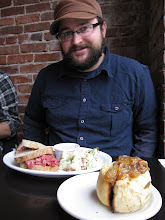

This week's interview is a trip down a very long road of beer journeys, beer recipes, brewer interviews, fact finding, and beer tasting. It's a look through pages upon pages that sit on many a brewer's shelf. This week's interview is with the one and only Stan Hieronymus. My first introduction to Mr. Hieronymus' work actually resulted in a huge turning point for me in my understanding of the business side of beer. A wealth of beer writers all turned up to debate in a post on one of Stan's blogs, Appellation Beer, and I proceeded to see the multi-faceted monster that is beer writing. Many people know Stan from his book Brew Like A Monk (or more recently Brewing With Wheat), but I wanted to dig a little deeper so we could know Stan beyond bound pages and blog entries. Ladies and gents...Stan Heironymus.
Since writing is a singular act that's broadcasted out to a world of readers, how has putting beer into your own words affected your personal understanding of your relationship with beer itself? What has writing taught you about the people of the beer world and the places where beer comes from?
I write about beer for several different audiences, notably consumers, the selling trade, the brewing trade, hobbyist brewers - there's obviously a lot of overlap. Doing my job well means thinking about what beer means to the reader - which, when things are going smoothly, might also be what really matters to me. It's a good day when I learn something, and a better one when I can tell other people about something new to them or cause them to think about something else in a new way.
Goofy as it might sound, writing about a brewer isn't necessarily any different than writing about a high school music teacher who began coaching the tennis team because one of his star pupils asked him to (something I did in an earlier life). I enjoy watching people figure things out. One of the best ways to learn about and from a brewer is talking to him (or her) while he (or she) is at work - meaning the brewer may interrupt our conversation to get something more important done.
Place? The best beers come to life in a very particular place and are particular to that place. Of course place can elevate an otherwise pedestrian beers to pretty substantial heights when it comes to life again in the glass, or - unfortunately - wreck the best of beers.
I love the tagline to your blog, "In Search of the Soul of Beer". In your five years of writing Appellation Beer, how close have you gotten to the soul of the matter?
I've had some fascinating conversations with brewers about the essence of beer or what constitutes "soul." A bit surprising because often these are "meat and potatoes" guys, who know the science of beer inside and out. I'm still asking the questions, but one of these years I guess I'll have to come to some sort of conclusion and put it on paper (or a screen, of course). One interesting idea suggested by a brewer who seldom puts his boots on anymore (such is how the business works - supervising is important) is that the energy - soul, if you want - that the people doing the physical labor put into a batch has to “go somewhere.”
In your recent Beer Rules, you write that, 'You cannot know all there is to know about beer', and you're the same guy that gave us 15 chapters on one grain in "Brewing with Wheat". Is it comforting or maddening for you that you can break something down all the way to its core (or multiple cores, I suppose) and still admit that you can never learn everything about it?
It can be liberating. If you waited to "know everything" you'd never be able to write anything. One thing I love about brewing is that there is not just one way to do things. I try to present a range, talking to brewers about the choices they make and why. Of course, it helps if readers are on board with the idea. My books occasionally get panned by people who expect more absolutes.
What was it about brewing with wheat or drinking wheat beers that made you decide to write a book dedicated to brewing with it?
Honestly, it wasn't my idea. Ray Daniels, still the head of Brewers Publications at the time, suggested BP needed a book on wheat. Since our family was planning a sabbatical that would take us through regions closely associated with wheat beers (Belgium, the south of Germany, Berlin, Leipzig, Portland, Kansas City) I wrote an outline.
I had to find a story, or a collection of stories, that wasn't contrived. We talked about a book that might have included "alternative" grains - that is everything beyond barley. Rye is certainly worth of writing about, and there is a spelt subculture that merits at least a magazine article. But wheat, and wheat itself, made a complete story.
The research portion alone for "Brew Like A Monk" seems like a dream come true for many beer drinkers. Was it? What was the process of pulling your material together like for that book?
I wish the research could have been more leisurely. Something you should allot years for.
The monastery brewers totally spoiled me. I went in thinking the book would be American-centric. How Americans brew beers inspired by the Belgians. First, I was surprised that I even got into the monastery breweries. I believed what turned out to be a myth, that everything about brewing in Belgium is secretive. Of course, I benefited in part from the timing. For instance, Rochefort was just beginning (in 2004) to become more accessible. I really don’t know why the monks at Westvleteren opened their doors to me. Anyway, the brewers kept answering my questions so I asked more. They didn’t provide complete recipes, but everything about process (pitching rates, fermentation temperatures, times, bottling regimen, etc) that constitutes the how.
That's what spoiled me. Now when I visit any brewery - be it in Germany, Italy or Texas - I'm disappointed when brewers are reluctant to share what they seem to consider secrets.
Speaking of myths, I learned early on researching the history of monastery brewing how much misinformation was/is floating around. Really, not only history, but facts about current practices and ingredients. Just because you can read something on the internet, and in multiple languages, doesn't mean it is accurate. You need to track down source material, or find references that already have, and you need to talk to the people actually brewing the beer.
Because I thought at the outset it would be focused more on "the American way" I mailed just about every American microbrewery then making an "abbey style" beer to learn more about their approaches. I included an offer to ask the questions they really wanted answers to when I visited Belgium. Understanding what they needed to know, and getting answers when I could - or at least presenting the options - became central to the book. So I did that again for “Brewing With Wheat” and will again for the next book.
Is there a new book in the works? Other than maintaining your multiple blogs, what are you up to?
The next book will be called "For the Love of Hops," so you can guess the focus. It is the second in Brewers Publications' four-part series about ingredients. The first, about yeast, just came out. The others will focus on water and malt. You'll see less writing in my blogs in the next year because this book is going to take most of my time. A lot to learn, then to write about. I’m excited and terrified. It will be out in September of 2012.
Like with "Brew Like a Monk" and "Brewing With Wheat" I'm collecting questions that potential readers would like to see answered. Anybody can pitch in at www.fortheloveofhops.com.
The Fantasy Beer Dinners portion of your blog is such absolutely fun reading. Could you give us some insight on the guests you chose for your personal Fantasy Beer Dinner?
Thanks. I picked four who I think would strike up a conversation I could just sit back and enjoy. Much of what I do involves collecting stories. Some great ones to eavesdrop on here.
I started with A.A. Applegate, my great grandfather. He was a berry farmer in central Illinois, and a lay preacher and the local correspondent for two area newspapers. He also ran for local office on the Prohibition ticket. The other choices were Woody Guthrie, Williams Shakespeare and Tom Wicker, who I hope anybody reading this knows wrote (and still writes) excellent fiction and non-fiction. Four masters of communication - you'll have to trust me about my great grandfather - but I expect the ideas they'd discuss ultimately would be more interesting than talk about how they communicated with readers or listeners.
Because of A.A., I was thinking in terms of comfort food, the sort of meal he would be offered in somebody's home after preaching a Sunday sermon. Maybe I should have thought it out better. After all, A.A. didn't drink. Session beers, whatever they are, go well with comfort food. So how about an old-style (meaning one with a little more hops than you get in Munich these days) helles or British bitter with the meal?
Ok, fantasy question of my own here....Bottomless case: What's the one beer you want a case of that will never run dry?
This isn't the only beer I drink from now on, right? And it would always be fresh?
If so, Westmalle Extra, brewed about twice a year for the monks themselves to drink. A little over 5% abv, very dry, wonderful noble hop flavor and bitterness. Simple, but beautiful.
Read more!
Friday, March 25, 2011
Week #12 - Stan Hieronymus


Friday, March 18, 2011
Week #11 - David Gonzalez

Keeping up with the Charlotte Craft Beer Week theme of last week with Darrin, this week we're talking to Dave Gonzalez of Alternative Beverage in Belmont, NC. Managing operations and brewing on the store's Brewmagic system, Dave continues his role as an important member of North Carolina's expanding craft beer landscape. Another story of a from up North finding his home in the South, Dave's brewing career began in Maine at Belfast Bay and continued with the Gordon Biersch Group where he called Rock Bottom his home for a good many years. Now homebrewers and curious beer fans have full access to his knowledge and expertise at Alternative Beverage.
You've been up and down the East Coast a bit so far in your brewing career. How did you get your first apprentice gig in New York and what led you up to Maine for those early brewing years of yours?
Yeah, I'm from Long Island, New York, and that's where I got my start. I went to college (SUNY-Stony Brook) to become a History teacher. After I graduated, and waiting for the fall to start teaching, I got a job in a beer distributor. We literally had 100's of different beers on our walls. So, every day, I would go home with 2-3 different ones to explore the world of beer. One day, I was in a coffee joint near where I went to school. I was wearing a sweatshirt from a brewpub (now defunct James Bay Brewing Company) across the street that I had gotten. When I turned around to leave, the guy behind me was wearing the same shirt. So, we started chatting and bs-ing. Turned out he was one of the owners and Head Brewer. When I told him about my interest in beer and brewing, he invited me to spend a day with him. So, I did, and got hooked. I was spending any available time there. Eventually, after a year, I gave up teaching and was working at the distributor and brewery all the time. After some time, they convinced me to go to brewing school (Siebel). So, I did. By this time, this brewery was closing, so I went back to the distributor full time. What led me to Maine was my folks. They had gone up there on vacation. One of the guys I worked with at James Bay had moved up there to start up a place. I told my folks that if they were in the area of his brewery (now defunct Rocky Bay Brewing Company) to stop in and say hi for me. Well, they did; And my Mom wanting me to get a gig suggested that I work there. So, I did. I was there for a few months, then went to Belfast Bay Brewing Company (I actually was living in this town: Rocky Bay was located in Rockland; 30 miles south of Belfast). By the time I took that job, the girl that I was living with (from NY too) and I had decided to move to North Carolina due to friends and family being in the state. btw- she is not whom I am married to (LOL).
I had known someone at Carolina Beer and Beverage (right when they were first starting). He invited me down for an assistant brewer's interview. I didn't get a definitive answer from them, but was moving to the area. I walked into Rock Bottom and got hired on the spot. The rest is history.
How would you describe Siebel's effect on your approach to the craft? Did the Brewing Technology short course give you more of a fine tuning of the knowledge you in with or did you walk away with a head full of new information?
I took Siebel's Short Course in Brewing Technology in June 1997: A long time ago. When I did, I had only apprenticed (worked for beer) at James Bay BC. So, I had only been in a small brewpub. When I took the class there were folks from Miller, Coors (seperate at the time), Guinness, Heineken, etc. So, the class was geared towards the bigger guys. But, I did take the info I learned and applied it to the smaller scale. Even though I had done a bunch of reading (being a homebrewer first), I was still new to the industry and making beer commercially. That being said, a lot of the information was new. Though, like I said earlier, some of it I could apply and use. For me, the best, and favorite, part of it was the sensory evaluation classes: getting to know off-flavors and why. Theory is theory and hands on is hands on.
Are there any mistakes you made as a young brewer that you think back on now and just shake your head?
Of course! Everyone does it. If they don't they're lying (LOL). I have recently made mistakes and said the same thing. Being a brewer is constantly learning and adapting.
What can you say about brewing under the 'corporate structure'? A younger version of myself was definitely guilty of avoiding Rock Bottom for a while, until I realized that one of my area’s really great brewers was working there. Is there a lot of stigma behind brewing for a chain or is there still a lot of room to express yourself with the beers?
Corporate brewing has its advantages and disadvantages (though, any situation has this). I'll say it was interesting. I remember when I first started with Rock Bottom/Gordon Biersch, I was telling a well known beer writer (that I'm now very good friends with), and he saying, "Why would you want to go there? They go through brewers left and right." I was shocked. Though, my career with them lasted 11+ years. Yeah, there are a few corporate brewing chains out there, but to be honest, they have mostly great brewers that make great beers. I thought the same way as you about Hops. I have a friend who still works for them who makes great beers. You just have to go in, get to know the brewer and try their beers for yourself. Everyone, and beer, deserves a chance.
As far as part two of this question, it depends on the corporate structure (look at the give a beer a chance statement above). With my last employer, there was some that was mandated, and some creativity. It all depends on the situation.
To this day, what's the best batch of beer you've brewed or your biggest personal accomplishment as a brewer (...or both)?
I never like to pat myself on the back. Though, there have been times (LOL). One day, my wife and I were sitting at Rock Bottom's bar sipping on a pint, and I said, "Man, that's really good". Nikki said, "See, you do make good beer." It was a Belgian Witbier that I had come up with the recipe (btw- that batch lasted 7 days!) There are a few others. The Spiced Pumpkin Ale I made for a few years I take pride in. The reason being was that my boss at the time HATED pumpkin beers, so I had to convince him to let me do it (show him the numbers of how that style of beer sold in this market). he eventually "caved" and let me do it. There were also a few cask beers that I'm proud of: The Mexican Devil (Jalapeno Tequila Pilsner), and The Yeti (Bourbon Stout) (this one I won a Gold Medal with). I also brewed a batch of Prospector's Pilsner that won a Gold Medal that I'm proud of. When it was announced, it was the first Gold Medal of the night, and the other folks in the room I think were caught off guard. I think I got a lot of respect that night (LOL).
I know you've got some beer distribution experience under your belt as well. What do you like about that side of the business?
I actually like that side of the business a lot. The place was a small mom & pop, but did decent business. I liked the work and people there. I still have good friends that work there (12 years after I left).
As far as that side of the business, even though you have competitors, there's camaraderie. Though, in brewing, I call it fraternal. Most everyone will help each other out. So, there's that difference there.
You have been in Charlotte for over a decade now. Just from what I know of conversation, Pop The Cap, changes in the market, etc there has been a great deal of change in beer culture in North Carolina. How has Charlotte adapted with that change? Has Charlotte come into it's own yet in the beer realm?
I think Charlotte, as well as the rest of the state, has expanded it's taste buds because of Pop The Cap. There are so many more beer places, more variety of beer in the market and being brewed in the market because of it. Even at Rock Bottom, when I first started there, the Light Lager out sold any of the other beers. Over the past 5-6 years, I noticed a change in the product mix of the IPA, Brown Ale, etc moving up, as the Light Lager went down and then the numbers became equal. There were many times, then these other beers out sold the Light Lager and such.
Though, I still think Charlotte has some room to grow. I've heard it referred to "Nascar Country" and "The Bible Belt". So, there are plenty of folks who love their lighter beers, or no beer at all. It's changing, but I still think it has a ways to go.
Can you explain your involvement with Charlotte Craft Beer Week? What are some of the goals that the committee has for 2011?
I am on the Board of Organizers for Charlotte Craft Beer Week. This coming year will be year #2 for us. There were a few other "beer weeks" in Charlotte in the past (that I advised on), but CCBW is different: Better, more diverse.
You ask a good question. I think basically educating Charlotte and it's surrounding areas of what a great beer place it can be. Having educational, fun, and great events that go well and are well attended. Getting the name that Charlotte is a great place for beer!
If you could have one beer always waiting for you in the fridge after a long day of brewing, what would it be?
A cold, free one (LOL). That's the typical answer. Seriously, there are many. I'm not necessarily a fan of specific beers, but styles. Yes, I have beers that I absolutely love, but I constantly like to try beers that I haven't had before or not in a long time. I guess one beer would be Olde Hickory's Bardstown Brand. It's freakin' unbelievable! But, I don' t know if I'd want that after a long day of brewing.
To answer this question, there's a time and place for almost every beer. What I like is beer memories. I remember playing softball with a company my Dad used to work for. At the end of the inning, on a hot summer day, I went to the cooler, dug my hand in the ice water and grabbed out a can of Budweiser. I chugged 3 cans before the inning changed, and it tasted fantastic. Though, I will RARELY go to a bar and order one (I can't remember the last time I had one). It's all in the time and moment.
Everyone in the business is somewhat of a "beer geek". I guess I am too. Ever since I was 18 (shh...don't tell my folks) I have kept a list of all the beers I've ever had. I think I am currently around 3,800 different brands.
Read more!
Friday, March 11, 2011
Week #10 - Darrin Pikarsky

To celebrate the official kickoff of Charlotte Craft Beer Week 2011 today's interview is with one of the key links in the CCBW chain. Darrin PIkarsky has been an integral part of Charlotte, NC's burgeoning craft beer scene. His Charlotte Beer Club has exposed hundreds of the Queen City's residents to great craft beer from their hometown brewery to beers from all corners of the globe.
Taking his efforts a step further, Darrin and several other appointed committee members joined forces in 2010 to organize the first Charlotte Craft Beer Week with great success. In it's sophmore year Charlotte Craft Beer Week will boast another schedule filled with great, focused beer events.
Ladies and gents, get to know Darrin Pikarsky...
As a Charlotte resident, you've done quite a lot to help grow beer culutre in the Queen City. Did you originally take on projects like Charlotte Beer Club and Charlotte Craft Beer Week because you saw a void that needed to be filled or was it more of an attempt to add to an already thriving beer culture in your city?
It was definitely more of a large void that needed to be filled in Charlotte. I had been enjoying craft beers & great imports from Europe since the late 80's in Syracuse NY before moving here in early 1999. In '99, there were slim pickins' to choose from due to the low limits on alcohol in North Carolina. When 2005's "Pop The Cap" removed the alcohol restrictions, the growth of craft beers started to find its’ way to Charlotte. Festivals were far and few in the state as well. I remember the 1st ever Charlotte Oktoberfest, there was like 100 people there (if that!). Now there's 5,000!
How has Meetup.com allowed you to find so many people in Charlotte interested in craft beer? I think the number of members is over 1,000? How many of members do you have actively coming out to events?
Meetup.com was something I stumbled on while doing some research on real estate networking. I quickly discovered it was the right place to pull people together with various interests. Charlotte is a highly sought after city for people looking to relocate from other cities. People from great beer states miss their hometown brews. By our "Mem-BEERS" requesting them from retailers and distributors, our demands are being met, of course there's ALWAYS room for more brands here. The number of members is now over 1,000 in about 2.5 years. We have approximately 300-400 that come out on occasion and another few hundred that come out every few months due to traveling and family commitments. Sometimes I don't see members for 6 months and they'll pop in to an event because it's a brewery they miss from home or something they haven't tried yet. They make it perfectly clear to me that they are joining us for their love of great beer.
I've been to several Beer Club events and even had the pleasure of presenting beers to the group. How do the events come about? Do bars and restaurants come to you looking to do something in particular or are you and your fellow organizers out there pitching events to different venues?
Dr. Joel you are always welcome to any and all of our events. You're like a cult hero, the crazy uncle or a Muppet to us, I'm not sure which one or maybe it's a combo of all 3 (LOL!)! It's a little bit of both. I'm very selective in where I will do a Charlotte Beer Club event. I have many places throughout Charlotte calling and emailing me. I receive about 25 requests per week for us to come out to various establishments. I decline most offers since most of them are looking to make a quick buck off of a large group. This brings me to hit the road and visit the familiar places and try some new places to book events. I book all the events myself. If it's not a good fit or good event, I blame myself. I have too much invested to let others book my events, plus it keeps me up to speed on the Charlotte beer scene, getting around town.
Can you describe for me the months and weeks leading up to the first Charlotte Craft Beer Week? All of the events I was at were well attended and a lot of fun. How many hours would you say that you and the rest of committee put into the planning side of CCBW?
We are heading into our 2nd year. The months before last year’s event, started out with me hitting up a group Charlotte beer enthusiasts that know the Charlotte beer market inside and out. I asked them if they would back me and be a part of the committee, if I put this together. They are a great bunch of guys. I have known all of them for a good number of years in Charlotte. The guys in the committee have been a huge part of the Charlotte beer culture over the last decade. We have brewers, brewery owners, distributors, regional managers and others that were very excited to be a part of this. We all volunteer our time and donate our time. It's truly a grass roots effort. Each event last year and this year is hand selected by the CCBW committee. We know events. We know what works in this market. We meet a few times a month until we get into the 90-120 day window, then it's many times per month.
Do you have a favorite event or favorite moment from last year's beer week?
I was a proud poppa last year for our inaugural CCBW. Obviously I couldn't make all of the events. I think I made about half of them. I would have to say The Freak Fest at The Common Market in South End was my favorite. We had great beers including one off's and a cask, a ton of people of all ages and a live freak show. A girl on a bed of nails, fire swallowers, human pin cushions, a live punk band and much more. It was unbelievable to see the reactions to the entertainment from the crowd. What a blast! Although, I heard from others on the committee that the Beasts Of The East Big Beer tasting and The Cask Festival were great as well.
With one year under your belt what big lessons came out of the initial execution of beer week?
We do not want to get too big too fast. We still want to hand select every event to ensure quality. We want everyone that attends to have a great time and we want every brewery and hosting establishment to get a good crowd. It's easy to open up your calendar and let everyone do whatever you want and have 2, 3, 400 events. You can't ensure good events that way, we don't want that. We're more of the thought of quality not quantity. A few great, hand selected events every night.
Several cities in North Carolina have their own identity when it comes to craft beer. Asheville has a ton of local options, the Triangle has its’ own brewing scene emerging, all the way out on the coast Wilmington has some great places for beer. How would you describe Charlotte's craft beer identity?
Charlotte is lucky enough to be right smack dab in the middle of it all! We get it from all sides. Charlotte is definitely about one to two years into a beer revolution and I do not think we are even close to peakin' yet. Our identity would best be described as the cog that turns the wheels in the surrounding cities.
Do you have a favorite place to sit down for a beer in Charlotte?
It would be my front porch or back patio with a Belgian, barleywine or imperial stout and a cigar. There are new places popping up all over the Charlotte region. I enjoy a place with a decent selection of beers and comfortable surroundings. I'm not one typically for loud bars that are 6 people deep.
Ok, so let's say a beer bar opens up right next door to you. The owner decides to let you choose one beer to be on tap for as long as your neighbors. It can only be one beer, but he'll keep ordering keg after keg. What beer are you putting on tap?
Ohhhh you're good Dr. Joel, really good! If a bar would open up right next door to me, my go to beer would be...Brewery Ommegang Abbey Ale from Cooperstown NY. It's a city I have visited many times over the years going to the Baseball HOF before the brewery was there. It's only about 2 1/2 hours from my home town of Syracuse NY, so consider it a homer selection. It's very easy to drink with an incredible nose. It gives me a taste of Belgium while supporting our own local craft breweries in the USA.
Read more!
Friday, March 4, 2011
Week #9 - An Bui

Behind every craft beer drinker that has found beauty in beer that’s full of flavor and made with honest ingredients there is someone that helped them get there. Always enthusiastic, helpful, and magnetic in their exuberance for the art of craft beer, this gateway ambassador is there with the right beer at the right time. An Bui is that guy. An’s excitement for craft beer is contagious to the point where telling his customers about great beer isn’t enough – he’s gone viral. Whether you’re sitting at Mekong in Richmond, VA or watching An’s Beer TV on youtube there is no chance that his love of beer won’t draw you in too. I believe that An is in Belgium as I type this, so let’s consider this week’s interview a toast to a man that is right where most of us would rather be right now.
Ladies and gents, get to know An Bui.
Mekong is one of the only places I know of on the East Coast that's marrying craft beer and Vietnamese food. Have you turned a lot of customers onto craft beer who were just coming for great Vietnamese food?
YES! We've found that Mekong's food and craft beer make the perfect pairing. Our customers enjoy unique experiences and I think the chance to experience something new, like Craft beer and Vietnamese food together, has become an attraction.
With all that you do to educate people about craft beer through Beer TV and events like World War Beer a few years ago, do you think you've been able to give craft beer drinkers in Richmond a new appreciation for Vietnamese cuisine?
I'd like to think so. We are equally as passionate about our food as we are craft beer. I think customers who come for our beer selection are intrigued by our cuisine. Mekong takes great care in providing a well rounded experience. Passion is the key. If someone sees that you are passionate about something, and take great care to cultivate an experience, then they are intrigued.
What was your introduction to craft beer?
I was going to a party in high-school, and always hated the taste of the beers there, so I grabbed a Paulaner Salvator off the shelf, simply because I liked the label. It was sweeter than I'd had before, and very drinkable. The rest as they say is history.
What are some of your favorite styles of beer? What styles are we most likely to find on tap at Mekong?
I love Belgians, IPA's, and Sours. Mekong has a wide variety on tap. Changes daily. Lot's of Belgians and small craft beer. I'm an avid supporter of small craft breweries. You won't find any larger corporations on tap at Mekong.
Do you have a favorite beer moment or event so far that's happened at your restaurant?
January 2010. Mekong held a "BFM Beer Tasting". Brasserie Des Franches-Montagnes. Amazing, amazing experience.
How would you describe the 'beer scene' in Richmond?
I would describe it simply as, a revolution. The "beer scene" is rapidly growing and expanding everyday. It's a wonderful time to be in Richmond. Here, peoples’ eyes are constantly being open to beer’s potential. I couldn't be happier!
I love Beer TV! What made you decide to start doing the show?
I wanted to share my knowledge and passion with as many people as possible. I feel it's important that everyone become aware of the possibilities of beer. It's an art form, and the more people who understand that the better. As I said before, beer is my passion. It's my life and my love, second only to my family. I want to open communications with beer lovers from all over the world, I would like us to become one big, united, global beer community. This is a way to do that .
Any beer events in the works for 2011 that we should put on our calendars?
Yes! We will be tapping an aged barrel of New Holland's Dragon's Milk for a very special event!
Read more!
Friday, February 25, 2011
Week #8 - Sean Lily Wilson

My first introduction to Sean Lily Wilson and Fullsteam Brewery was much like many, many other peoples': I heard about it on the internet. Fullsteam has a lot of buzz to be buzzing about, but one of the great stories leading up to the brewery's opening was how cool this brewery and these dudes...seemed. You already knew them because they were hitting social media with a full court press. Fast forward to CBC 2010 and the Storytelling panel that has popped up numerous times in this interview series: Sean's assessment of how social media made Fullsteam a regular name before an ounce of beer hit the market was majorly impressive. Fast forward yet again to the current: Fullsteam's approach to brewing for their community, including their local producers, and lifting many ships with their mighty tide is the feel good story that you may not have heard yet and the story is, in many ways, textbook for how to get your beer on the radar in this digital age. Ok, now rewind. North Carolina pops its 6% abv cap and Sean Lily Wilson was right there in the trenches.
See this man, shake his hand, cheers his beer and get to know Sean Lily Wilson...
With Fullsteam you celebrate and highlight many of the wonderful crops and traditions of the South. Is the brewery the culmination of two ideas coming together: Wanting to open a brewery and wanting to find a way to support your local producers on a large scale or was the idea always to open a brewery that utilizes locally grown ingredients?
Southern ingredients and Southern traditions were always central to Fullsteam’s concept, ever since brewer Chris Davis and I first envisioned starting a brewery four years ago. We changed our mind plenty along the way: our first idea was more farmhouse brewery and restaurant. Over time, we realized that Durhamites wanted a hometown brewery more than a brewpub/restaurant. But the common thread was always incorporating local ingredients in the brewing process.
I love Fullsteam's ultimate goal of a brewery sustained fully by what's within local means. Agriculturally, what would have to change to make that happen? Is malted barley the biggest obstacle?
Yes, our biggest challenge will be obtaining locally-malted barley and local hops, which account for the overwhelming majority of beer’s farmed inputs. It’s one thing to brew with local adjuncts – the most local we go is Carver, which is brewed with 500 pounds of local sweet potatoes per batch (one-third of the beer’s base fermentables). But our goal is to make Fullsteam Southern Lager -- heck, all of our beers – as local as possible. This includes local barley and hops. Yes, it’s ambitious – but with new strains and advances in farm sciences, I see every reason to believe that local hops and local barley is possible in my lifetime.
We want to encourage farmers that if they can grow it, keep it consistent, and price it fairly, we will buy it…and we believe customers will buy local. The biggest challenge I see isn’t in the growing of these items, it’s in the post-harvest infrastructure: the malting and kilning of grain; the threshing, drying, and pelletizing of hops. And, of course, pricing the ingredients competitively.
Our vision is to make distinctly Southern beer. If that means our beer has a slightly different character because we use regional ingredients, then that’s a success in my book. Of course, all this presumes that quality and taste are never sacrificed.
How did you hookup with Brooks Hamaker and Chris Davis? What do each of you bring to the table to make Fullsteam a reality?
Chris and I met at a Pop The Cap dinner I hosted at the Carolina Brewery in Chapel Hill in 2006. We kept talking and scheming, and I have an incredible amount of respect and appreciation for Chris’ patience as we worked to make the brewery a reality.
As we got closer to finding equipment and nailing down a space, it became clear we needed a “been there, done that” professional. A mutual friend of Brooks’ and mine, Dean McCord, introduced us at the 2009 Southern Foodways Alliance symposium in Oxford, Mississippi. Brooks, Chris and I had actually met at the ’08 SFA symposium, but Dean suggested we start talking specifics. Brooks was the founding brewer at Abita and was looking to get back into brewing.
It’s one thing to know how to brew beer, but it’s another skill entirely to know how to set up a brewery. Brooks brings both skills to the table. He also tends to favor more traditional beers, whereas Chris, with his homebrewing background, is more about experimentation and pushing the envelope.
I focus on front-of-the-house tasks like sales, delivery (for now), tavern management, marketing, and social media. Beer-wise, I bring some ideas to the table, and Chris and Brooks generally take them to the next level. For example, while I had the idea for Working Man’s Lunch (a beer inspired by MoonPies and RC Cola), it was Brooks and Chris who schemed up the idea of using a Weihenstephan yeast to throw off some vanilla and banana-like notes to the beer, to mimic the sweet biscuityness of a MoonPie. I wouldn’t have thought of that.
With two product lines representing two different roads you're going down on the brewing side, have you seen more reaction towards the Workers' Compensation line of true-to-style beers or more on the side of Plow to Pint beers utilizing ingredients like sweet potatoes, persimmon, and house-smoked malt?
The Fullsteam business plan states that we “expect to be known for our Plow-to-Pint offerings, but we’ll likely sell a lot more of the Workers’ Compensation beers.” I think we got that just about right. Many people know we brew a beer that smells and tastes like bacon (Hogwash, a hickory-smoked porter), but it’s our only bona fide slow-moving beer. We sell a lot more Fullsteam Southern Lager and Rocket Science IPA. That said, Carver sweet potato lager is a huge hit, and that’s in the Plow-to-Pint series.
Sometimes it’s hard to know how to categorize our beers – like Working Man’s Lunch. It’s not really “Plow-to-Pint,” because the ingredients aren’t really local. We do use local chocolate from a great artisan purveyor out of Raleigh, Escazu. But it’s not a “true-to-style” beer, either…because of that whole hefe yeast thing, which makes the beer more of a dark ale than a traditional stout. And people reading this might think, “whatever, it’s not a big deal,” but it has all these implications, from the eventual look of the label to the type of package it goes in. I guess I just don’t ever want our “series” approach to constrain us. If I want to brew a Black IPA, we should be able to do that. Is a black IPA “true-to-style?” If not, must we make it “Plow-to-Pint?” Our own labels can be a challenge.
I'm assuming there will be some seasonality necessary in the Plow to Pint lineup? How does availability and any inconsistency of raw materials (size, yield, difference in what flavors/sugars you're extracting) each time they're harvested affect the final product and your approach to production?
I liken our Plow-to-Pint approach to that of wine: agricultural products vary from year-to-year. We should celebrate this variance.
At times, it bugs me that most brewers make pumpkin beers from canned pumpkin (or spices that suggest pumpkin) in freakin’ July – when pumpkins are still green – just so the beer can match the season. Now I’m not naïve enough to think that a pumpkin beer should come out in December (after the pumpkin harvest and when the beer is finally ready), because people have been trained to get pumpkin beers in October.
But I really struggle with this.
Our industry marries beer to its social, cultural, and emotional contexts. Not its agricultural roots. It’s part of the reason most people don’t know what beer is made from – they know little to nothing of the harvesting methods.
We’re finishing up a beer called First Frost – it’s a winter ale brewed with 75 pounds of local persimmons. Southern tradition has it that persimmons are best after the first frost: the fruit is nice and sugary by then, and the unpleasant tannins are mostly eliminated. We started picking persimmons after our first frost, which ultimately means the beer won’t be ready until late January – well after the first frost.
Soon enough we’re going to see a warm-up in temperatures, and the last thing we’re going to be thinking about is the autumn frost date. So how does Fullsteam handle this? I don’t want to freeze persimmons to launch the beer the following October. That feels so inauthentic to me. I want to celebrate the harvest. People in the South should know what a persimmon is: when it’s harvested, what it tastes like, where you can find them. Is this a winning proposition for our customer base? Do we risk having a winter beer sitting on store shelves in April because we’re committed to working within the seasons? I don’t yet know. We don’t have a year’s worth of experience to know. But I love the challenge. Sorry for the long answer.
The first thing that sparked my interest about Fullsteam was hearing about the brewery during your panel at CBC and learning how much interest and buzz you'd created online before you were even open. How important was that initial period of raising awareness to your brewery as you built up your site and prepared to open up?
Oh man, that means a lot to me. We are very fortunate that Fullsteam’s build-out coincided nicely with the mainstream acceptance of social media. Not only did blogging, Facebook, and Twitter help us generate interest and excitement, but I know I secured some investors as they followed our story online. It wasn’t as direct as my friend and fellow CBC panelist Erik Lars Myers’ efforts (using Kickstarter to raise money for Mystery Brewing Company), but our online presence helped us raise money more quickly. No doubt about it.
To ramble on this a bit more: I am surprised by how “ordinary” a lot of brewery communication is online. Some of the best ongoing communication with our fans and friends is only tangentially related to beer: discussions on the best music of the year, crazy inventions from 100 years ago, odes to The Room and unintentionally bad movies. My goal is to talk with, not at. I like it, and I can’t think of doing it any other way. Though I admit it is a little jarring for some, particularly those who believe a business’ online tone and timbre should sound like traditional PR.
How many years in the making was Pop The Cap and what prompted you to head the campaign of bringing more sane beer laws to North Carolina?
The short answer: it took three years from wanting to change the law to actually having the law changed. That’s a pretty short timeframe, especially considering the push was to relax an alcohol law in a Southern state.
The long answer:
In 2002, a good friend of mine from business school, JP Cardona, invited me to an after-party. “You’ve never had beers like this before,” he told me. And boy, was he was right: beers I had never heard of…barleywines, corked-and-caged rarities, double IPAs. I thought I knew about craft beer – after all, I shopped at the local grocery store to buy Sam Adams and local beer – but I had no idea this world of specialty beer existed. Out of sight, out of mind, I guess.
That was my craft beer epiphany moment. JP told me that night about North Carolina’s 6 percent alcohol limit. I thought about all the incredible flavors I had just enjoyed and thought, wow, that’s a really stupid law. Especially because our state-run liquor stores sold Everclear. So I thought I’d try to figure out what it took to change the law.
Anyways, I was unemployed at the time. This was after the tech bubble, and I was a technology startup guy. So I was networking a lot, looking for work…and getting increasingly interested in craft beer. As I started networking in the beer world, I quickly discovered All About Beer Magazine and the World Beer Festival, located here in Durham. At that time, the head of both, Daniel Bradford, was also leading the Brewers Association of America (BAA), which has since merged with the Brewers Association.
I called Daniel, introduced myself, and in typical Daniel fashion, he had me working the next day, stuffing envelopes. Here I was talking beer and politics with Daniel, Julie Johnson, and Pete Johnson (now of the BA). It was incredible.
Within a few weeks, Julie and I had gathered a group together of about 40 people disgruntled with the 6% alcohol cap. Many of these folks were homebrewers, though the group also included some retailers and at least one beer writer (Tony Kiss of Asheville). We had enough of a spark from that group to get started, though we were incredibly naïve in knowing what to do. We thought a petition would help. A petition! It’s almost laughable now. We quickly realized we needed a lobbyist to represent our cause, and the inestimable Theresa Kostrzewa took us on as a client.
There’s a lot more to the story, but this is already crazy-long. It’s largely still online at http://popthecap.org.
I am enamored with beer culture in North Carolina. I love travelling there for work and have a lot of friends from up North that have traveled to NC for reasons strictly pertaining to beer. Since I've only visited post-Cap Popping, could you explain a little bit about what the beer landscape was like before the limit on ABV went from 6 to 15 percent?
North Carolina didn’t have the variety and scope, but it had the passion and skill. Breweries like Carolina Brewery, Highland, and many others were in-place and making great beer. The biggest impact was on the store shelves, where you just wouldn’t see the range of beer you do now. Of course, many more N.C. breweries have opened since 2005, but I think that’s generally a function of the craft beer explosion. More breweries are opening up everywhere.
Where would you say beer in North Carolina is headed? With a ton of great brewers, festivals, and a lots of awesome retail options, what should people peeking in from afar be most clued into about the future of beer in NC?
I suspect North Carolina beer is going to get more adventuresome. Our focus is using local ingredients and local traditions to try and define Southern beer. That’s our niche. As new breweries come on the scene, they’ll work to establish their own niche: farmhouse ales, canned beer, session ales, sours, and new approaches and angles. I believe it’s going to bring a friendly competitiveness that will push our state along in terms of beer innovation and creativity. Perhaps soon we won’t be looking westward for trends and ideas, but we’ll be developing our own in-state.
I do hope that, in spite of this inevitable competition, we remain collaborative and upbeat and relatively free of snark. It’s beer. It’s supposed to be fun. It’s the beverage of celebration and community. One of the GREAT things about North Carolina is just how upbeat its citizens and brewers are on craft beer. I’ll be disappointed if North Carolinians become jaded, seeking the unicorn instead of enjoying the moment.
How about Fullsteam specifically? What's on the horizon for the early part of 2011?
We just released our first sour beer, Sour Mashed Sweet Potato, and soon we’ll be releasing First Frost, the winter persimmon beer. Soon it’ll be time for Pastinaak, a farmhouse ale made with parsnips and Liborius Gollhardt, a sour rhubarb ale. Spring and summer can’t come soon enough.
Read more!
Friday, February 18, 2011
Week #7 - Billy Mellon

Billy Mellon (pictured on the left here) is one of those guys whose official job title tells only a small part of the story. Billy recently opened the stunning Manna in Wilmington, NC after a run on the distributor side of on and off premise alcohol sales. Those that know Mr. Mellon though know that he's a constant source of 'everybody wins' ideas to elevate beer, wine, food, music and just about everything in between. Voicemails from Billy in his distributor days usually started with a, "So hey I wanted to get your thoughts on something..." followed by a scheme to get your beer to a new audience in a new way that no one had ever thought of. This is the kind of guy that needed a constant canvas to paint on because he was just too good to leave his mark on everyone else's businesses. He orchestrated one of the coolest beer events I've ever been a part of last year complete with a hidden beer tasting amidst a rock and roll show. If you're in or travelling through the Port City stop in for a meal at Manna.
We met while you were in beer and wine wholesale, but you were in restaurants before that right?
I was "stolen" by the wholesale business from the food industry--nearly 20 years of experience.
How valuable of an experience is it for someone running a restuarant to have spent many of their days selling beer and wine to tons of other restaurants, buyers, chefs and owners?
It makes me understand the business end much better--a lot like when I switched from "buyer" to seller--now I am back as the buyer and I am more dialed into the relationships that occur between the two sides. I know how to better select wines, I am more comfortable with esoteric varietals and regions; I can relate to the salesman's situation much closer and I know the right "questions" to ask with regards to what needs to move and what wines/beers are at discounted prices, sales, etc...
How much of the sales perspective informed your approach to Manna?
Again, now I have the experience of how to get the most from my salespeople. I understand the practice of allocations (when they are available, how much, who's carrying them) and now I am a much better buyer with those key elements in my arsenal: basically, I am more informed=dangerous.
In what ways is the drinks menu at the restaurant is an expression of your fondness and experience with both wine and beer?
I have always been into networks. That said, I have tried to increase the web of those networks within the friendships/relationships that I have derived from the wholesale business. I try to support the artisans and be as local as possible when it comes to selecting wines and beers. I have focused my brands on those people who are in the business of selling "great" products and enjoy what they do--these people tend to work for people with those same goals...goals that I try to maintain within the framework of our concept. It makes selling them to customers more meaningful and the network grows.
The food menu is so descriptive. It's killing me being so far away! I know part of the goal with Manna was to elevate the dining scene in Wilmington and even though you've only been open a short time do you feel like you've begun to reach that goal?
We're on the right track but nowhere near where we want to be. We want to unify the culinary scene of Wilmington to be up there with the likes of the Charlestons, Ashevilles of the world. Hopefully, we can create a scene of successful restaurant groups that have the same goals as we do and make our city a destination for people who love to eat. No "scene" can be like that with limited options for dining.
Wilmington is such a charming city and really unique when compared to a lot of other cities on the coast. What do you like most about it?
It has a "grip" on me that I cannot explain. I moved here in '95 to live for a few summers and I have yet to leave. I've had many chances to leave: SF, Austin, Atlanta, Italy but always found more reasons to stay. I have a large circle of friends that span a vast group of people. it would be hard to replace all of those networks anywhere else. I mean, I have friends in city council, lawyers, doctors, builders, electricians, musicians, the list goes on and on. If I need something, I got a fix in my phone. Besides the beach adds something to the mix, too.
Ok, so Manna closes for the night. Where are you headed out to for a few drinks? And what are you drinking?
Satellite is still my go to spot. They continue to improve their venue--Dusty has added an outdoor movie screen (16 X 20) and a back yard "garden". It still has the best vibe and the best beer. I will typically have a glass of wine that I pair with what the chef makes me for supper and then it'll be a couple of craft beers: most recently, Cold Mountain and Terrapin Wake and Bake. (love to get a shot at picking up some of that New Holland hop tequila....hint)
You've turned me on to a number of bands just through your facebook posts. What's your involvement with Wilmington Unplugged?
I basically am the organizer of the "group". It's a monthly showcase highlighting local talent to perform on one stage with 4 other acts. They get 25 minutes to perform and I've got to meet and witness some fantastic artists over the last 4 years of the event. The monthly has spawned "Super Unplugged" where I branch out to find regional acts to play for a "listening audience" and pair them with the "best of the unplugged..." locals.
What should we be on the lookout for from Manna in 2011?
Hopefully, that we are still open and paying our bills. The goal is to be ahead of the curve in terms of our take on the American restaurant and never being satisfied with being "good"; filled with people who love our product and continuing to get better with every dinner and drink we serve; happy to be doing what it is that truly drives us....making food, beverage and personality "casserole."
Read more!
Friday, February 11, 2011
Week #6 - Dean Browell

Dean Browell is Executive Vice President at Feedback, an agency that takes Social Media to the next, well... a deeper, well... a more informed and strategical level. Feedback's research and analytical processes allow companies to make social media even more powerful and Dean is right at the heart of the matter. He is the next installment of interviews with the members of the Storytelling panel at 2010's CBC in Chicago and I find what Dean brings to the social media conversation just fascinating. Dean is a Richmond, VA resident and a big music fan. All of these things make him pretty cool in my book. Without anything further, Dean Browell...
The interaction of different age groups online has been a point of study for you, if you had to put all of craft beer into an age group where do we fall in line? In the realm of Social Media, do we get it? Are we getting there? We're hip, right?
Great question...
I'd say the hipness is growing, but there's still a ton of room for improvement. When you consider how relatively cheaply and easily you can utilize social media to grow an audience (compared to say, TV and print) combined with the fact that the people that would pay a little more for a craft beer are the same people who are likely online and savvy, it's a serious wonder that the entire industry isn't doing it better. Especially since so much about craft beer is about telling your story, this medium is perfect. That's what last year's panel with Charlie, Fullsteam and Erik was about ( http://alewhale.net/ ).
Here's the thing, and it's not at all just the problem of craft beer as many industries are facing this, but the craft beer audience is out ahead of the industry itself right now. It's a really odd thing that the average person knows how to market themselves online better than some breweries. (Can you imagine the average person being able to make TV commercials better than businesses in the 1960's?) My earlier statement about the craft beer buyers being likely to be online - well that's becoming more true for everyone across the board. Look at the Pew research from last summer with people over 50 making up nearly half of all social media users -- when the GRANDPARENTS of college-age drinkers are on Facebook, what excuses are left for not understanding the ubiquity?
There's something else that I want to point out, and I've been skewered in the past for saying it. In fact right before my first appearance at CBC I made a comment on Twitter and got jumped all over for it, but I stand by that initial outsider's observation: The online craft beer community has trended toward the divisive (reviews, critique, cynical fandom) rather than the inclusive. Not everyone is like that, but it doesn't take much prodding around to uncover elitism. And what is so stunning to me, and this is what got me in trouble, is noting that of all things the wine industry has managed to take the opposite approach and somehow be more inclusive. Years ago now there were massive social networks for wine drinkers online, all helping you find your taste, get comfortable in the environment and be proud about your own personal taste. Meanwhile in some craft beer forums you can get your internet throat cut for saying you really enjoy a mild over an IPA. When you see the socialization of wine online it makes me irritated because craft beer, in my opinion, is far more democratic and social an industry, but that's not always reflected. Sure wine snobs are still there and it's not like every vineyard has a Facebook Page. But where is craft beer's Gary Vaynerchuk (@garyvee) ? How did the snobbiest of all drinking pastimes manage to lap the pub crawlers? What's next, absinthe drinkers?
If I'm a craft brewery who's small and making great beer, but limited in the resources of time and availability, marketing-wise is there one thing I should definitely be doing online? Is an active and vocal following on Facebook more powerful than a website that may not get updated often enough? Is there a priority system with these online opportunities?
There are two necessary ingredients to a good social web presence: consistency and authenticity. If your website isn't updated regularly, don't design your website so it looks like it was supposed to be updated regularly (resulting in a "cobwebs" look). People know your website will say nice things about you, so LET IT - let it be the repository for all kinds of information. But then let the discussion and the "person behind the curtain" feel come through in social. The odd photo of the mash, the video of a tasting and reactions, asking your fans what they think of a new release... It's conversational. So what I would suggest is let the website be static if it means you'll have more time to keep the community aspect of a Facebook Page going. Commit to updating 1-3 times a week, even something small. Point people to your social presence from your website. But manage your expectations based on the time you put in. be on Facebook, at least. But take a long look at the geographies you serve and determine WHERE your audiences are talking and how and make an informed decision as to how to proceed. Not every city is the same. That's what we do at Feedback more than anything: research the cultures people serve and make informed recommendations as to how to intersect.
How about a craft brewery who is willing to commit some time and maybe even personnel to marketing and the world of social media, but doesn't know a tweet from a blog post? What services are out there to help them get started?
There are some great 101s out there. But my first bit of advice is do not go out and try and learn everything. Not every tool is probably right for you anyway. The one with critical mass is Facebook so that may be your easiest target. Sign up personally. Create a private group for your key personnel and communicate with each other. Try it out, see what it lets you do. Play. Same way you play with recipes. Get comfortable with the variables and the options.
Knowing that you're a huge music fan and seeing the impact of music's sales and distribution online, how vastly different is the social media game when your product can be fully experienced while sitting at the computer? To keep up, should craft brewers be trying to make beer as interactive as possible? Is there something to be learned from something so quickly gratifying as a download?
Well if there's a single lesson it's how the music industry let their entire audience get so far out in front of them without finding a way to tell their story, while individual artists who took the time to observe and play in the space ran away with the crown and actually made money (see: Radiohead, Nine Inch Nails) while reinventing the fandom and reaping live event money as well.
One thing craft beer can learn is how they can make sure they are encouraging fandom of their beers, brands, stories, even when people aren't sitting in front of a tap or with a bottle in their hand. That one guy from your pub who loves your Belgian White still loves it when he's sitting on an office chair instead of a stool, the difference is he can still be Tweeting and sharing his love for your beer even when he's not drinking it. Goodness knows that at 4pm he's already thinking about drinking it - why not encourage him to make others daydream about the same?
Interactivity is key, but it sounds like it's something new they have to learn - but it's not. It's the same interactions they've been having with new and regular customers their whole lives. We can just see it now. Word of mouth we can see.
When did you start drinking craft beer? Was there one beer or experience that sealed the deal for you?
I was lucky. My Dad is a big fan of trying new food from all over the world and we traveled a lot. So I was influenced very early to try things and not accept the norm. My Dad is still one of my favorite people to drink craft beer with, he recently brought back Andechs from Munich wrapped in his socks from a trip to Germany. Anyway, by the time I got to legal drinking age, ahem, I was also lucky enough to have college roommates with great taste in beer. One was from Malvern, PA and after every break would return with cases of Yuengling which was as "common" a beer we would ever drink - and then we'd go to a little craft beer and wine store called, The Caboose in Ashland, VA (we were at Randolph-Macon) and buy mixed six packs and try everything. So i wish I could point to a singular experience, but it was really just being surrounded by people who didn't accept the status quo and encouraged trying new tastes.
If we're coming to Richmond, VA and we want the following things where should we be shopping...
A meal of great food and great beer:
Capital Ale House (and they have a few in the area). Great food and a ridiculous beer selection.
Great sixpacks or big bottles to go:
The Caboose in Ashland, VA is still around: http://caboosewine.com/
But to be frank we're also lucky in Richmond that Legend is sold in most of our grocery stores.
Vinyl for our growing (no matter how obsessively) record collection:
Deep Groove. Hands down. But also visit Plan 9's basement.
A live show:
The National is a favorite venue for sure, but there's some great little places as well like The Camel. But you seriously can't beat a great show at The National.
Read more!